It started, as these small crises of self-awareness tend to, with an email. Time Out’s weekly round-up – fifty best new things to do in London this summer – landing in my inbox on a Tuesday morning with the cheerful energy of a labrador that doesn’t know you’re tired. I opened it. I read the first twelve entries. I registered, one by one, that I had not done any of them, had no particular plans to do any of them, and – this is the part that gave me pause – felt a faint exhaustion at the mere prospect of doing any of them.
I closed the tab. I made another coffee. I sat back down at my desk and thought: when did this happen?
I am a person who writes about London for a living, at least in part. I moved here not because I had to but because I wanted to, and have stayed not out of inertia but out of genuine love for the place. I read about new openings. I follow what’s happening. I am, in professional terms, reasonably well informed about this city and what it’s doing with itself in 2025.
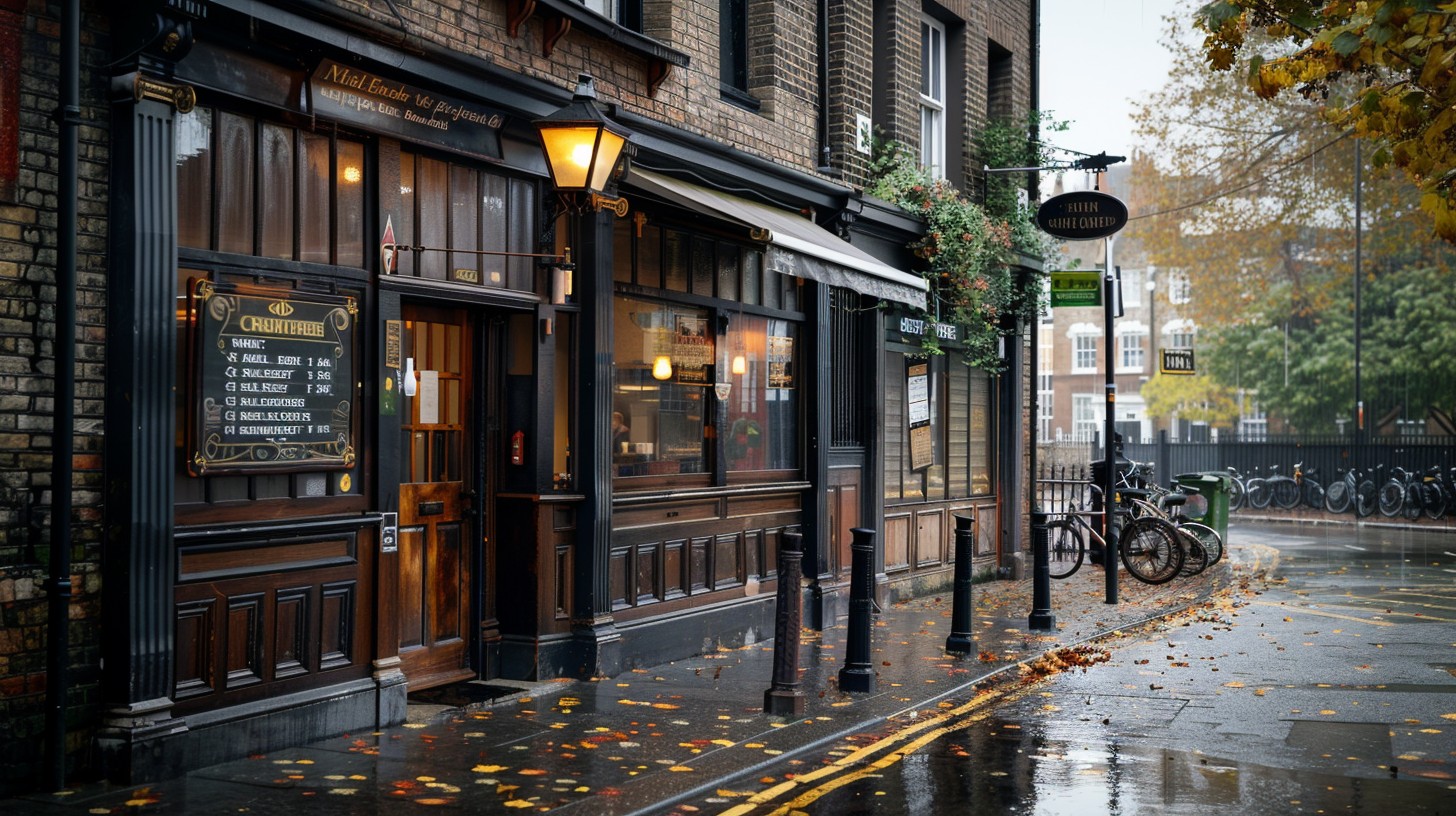
And yet. My honest, unvarnished answer to the question of where I actually went last weekend is: the market on Sunday morning, a walk in the park, and the pub on Saturday night. The same pub I have been going to on Saturday nights, with minor variations, for the better part of six years. The city has never had more to offer. My personal experience of it has never been more compressed. These two facts coexist in my life without apparent discomfort, and I’ve been trying to work out what that says about me.
The Honest Inventory
Let me be precise, because vagueness is a form of self-flattery here.
My three places are, in no particular order: the market on Sunday (extensively documented elsewhere on this blog), my local pub on Saturdays, and a Turkish restaurant on Kingsland Road that I have been going to since 2019 and which I will not name here because I have no desire to make it harder to get a table. The pub has good beer, imperfect acoustics, and a quiz on Wednesday nights that my girlfriend and I attend with a confidence that the results consistently fail to justify. The Turkish place does a lamb beyti that I think about during the week with a frequency that probably says something about my relationship with comfort.
That is essentially it. That is my London, week to week, if I am being ruthlessly honest about it. I live twenty minutes from some of the most culturally dense square mileage on earth – world-class galleries, restaurants representing every cuisine you could name, live music venues, theatres, markets, parks, pop-ups, immersive experiences, and a river that still, after years, makes me stop and look on a clear evening. I access approximately none of this with any regularity. I go to my pub and my Turkish restaurant and I come home and I feel, broadly, fine about this.
What London Is Actually Doing Without Me
To be clear about the scale of what I’m opting out of: London in 2025 is doing a lot.
The food scene alone – and I say this as someone who, again, eats at the same restaurant on a rotating basis – is in a period of genuine richness. The wave of West African cooking that’s been building for a few years has properly arrived, with restaurants in Peckham and Brixton and Hackney itself doing things with suya and egusi and jollof that are drawing serious attention. The natural wine bars have multiplied to the point where there’s now one within walking distance of almost anywhere in inner London, which is either a cultural golden age or a sign that we’ve all slightly lost the plot, depending on your perspective.
The live music picture is more complicated – venues are still closing, grassroots spaces are still fighting the economics – but what survives is often extraordinary. There are gigs happening in east London on any given Thursday night that people in other cities would travel for. I know this. I read about them. I stay in and watch something on television, and I feel fine about this too, which is either contentment or a warning sign I’ve chosen not to investigate.
Beyond my immediate neighbourhood, there are entire zones of London I haven’t visited in years. I realised recently that I haven’t been south of the river for anything other than a specific purpose in about eight months. South London – Brixton, Peckham, Deptford, the bits of Bermondsey I keep reading about – is apparently having a moment that I am fully, comfortably missing from the comfort of E9.
How This Happens to a Person
The psychology of the urban rut is, I think, underexplored, because the cultural conversation about cities is almost entirely oriented around abundance – what’s new, what’s opening, what you should be doing. Nobody writes a piece called “The Case for Going to the Same Pub Every Saturday” despite the fact that this is, statistically, what most people who live in cities actually do.
What happens is this. You arrive in a new place – or in a familiar place newly – with a wide aperture. Everything is potential. You try things. Some of them are brilliant and some are fine and some are quietly disappointing in ways that involve a long Overground journey and a forty-five minute wait and a bill that makes you briefly reconsider your life choices. And gradually, through this process of elimination and discovery, you arrive at your places. Your pub. Your restaurant. Your Sunday morning ritual. And these places, by definition, have been tested. They have earned the repeat visit. Returning to them is not laziness – it’s the logical outcome of a successful search.
This is what I tell myself, anyway. The alternative theory, that I am a nearly forty-year-old man who has quietly stopped being curious about his own city, is available to me and I choose not to take it.
There is also, if I’m being completely honest, a tiredness factor that I think goes underacknowledged in conversations about urban life. London is a high-effort city. The distances are real, the costs are real, the logistics are real. Going somewhere new in London isn’t simply a decision – it’s a project. You have to book, often weeks in advance. You have to get there. You have to be in the right mood at the end of a week of work, when the sofa is right there and Netflix has noticed that you tend to make poor decisions after nine o’clock and is ready with suggestions. The familiar place requires none of this negotiation. You just go.
When I Do Actually Go Somewhere New
To be fair to myself – a phrase I appear to be using a lot lately – I do occasionally break out of the circuit, and when I do, the results are usually somewhere on a spectrum between quietly pleasing and genuinely brilliant.
Last autumn I finally went to a restaurant in Dalston that I’d been meaning to visit for the better part of two years. It was outstanding. The kind of meal that makes you feel, briefly, like a person who has their city properly in hand. I said to my girlfriend on the way home that we should do this more often. She agreed. We have not been back. We have not been to anywhere equivalently new since. We went to the Turkish place the following Friday and ordered the same things we always order and it was, as it always is, completely satisfying.
There is a version of this cycle that is tragic and a version that is simply human, and I’ve decided to believe I’m living the latter.
What the Regulars Actually Give You
Here is the honest case for the three places, stripped of self-justification: they give you the thing that is actually hardest to find in a city this size, which is the feeling of being known.
My pub knows what I drink. The woman behind the bar whose name I finally learned after two years – I’ll spare her the exposure – asks about the West Ham result with a sympathy that I think is genuine, or at least generously performed. The Turkish place has started bringing the bread before we order, because they know we’ll ask for it. These are tiny things. In the context of London, which is enormous and often indifferent, they are not nothing.
The city will always have something new. The new thing will often be brilliant. But there is something that the new thing cannot give you on the first visit, or the second, or sometimes ever – and that is the specific comfort of somewhere that has figured you out and continues, inexplicably, to be pleased to see you.
That’s worth more than fifty recommendations in a Tuesday email.
The tab stays closed.